


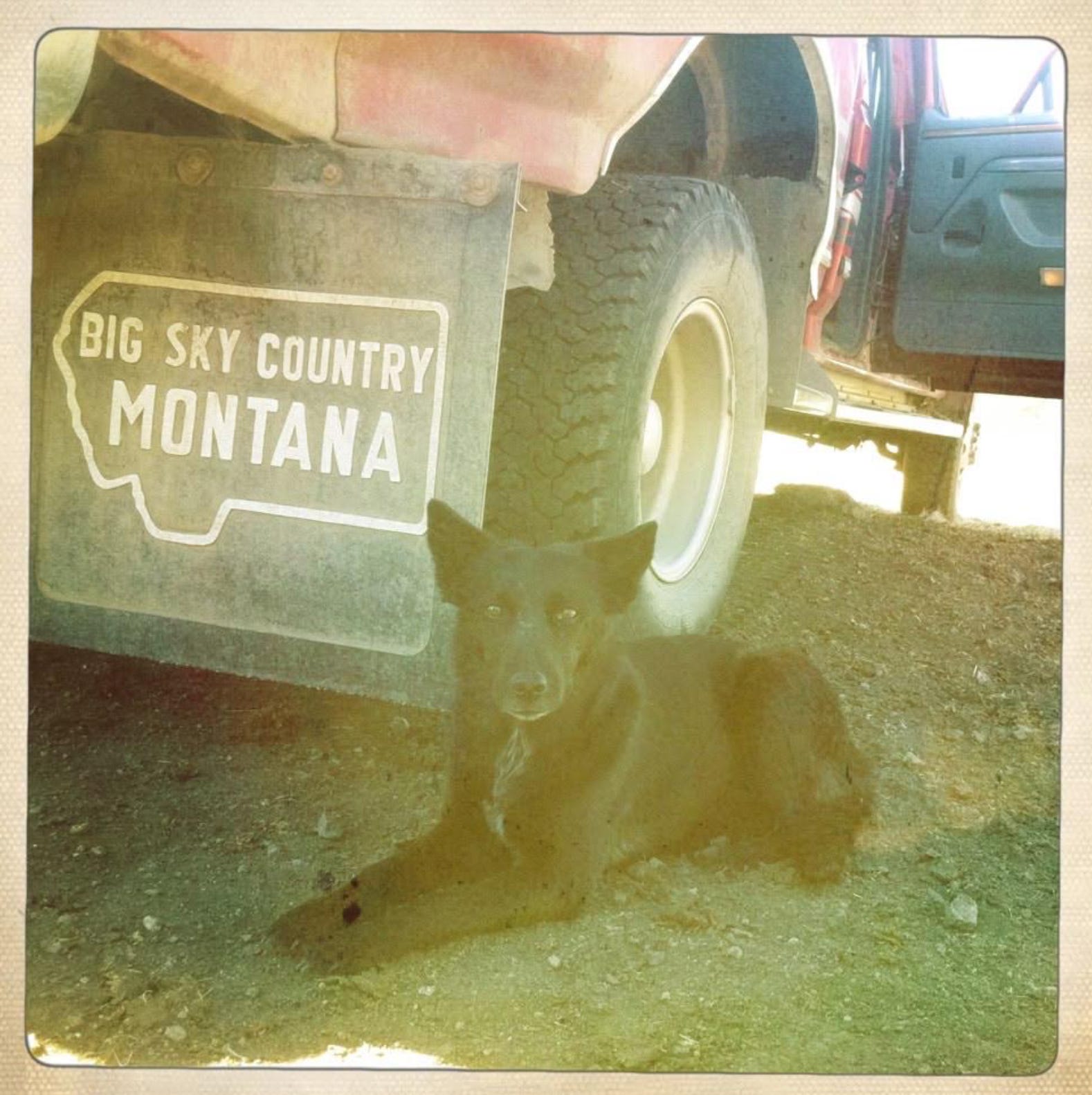
Benton looked out over the old pasture, past the broken-down pole fence, at three blue, snow-capped mountains standing just the way they had his whole life long. Eighty-nine years of life. It was enough life for Benton. But it kept coming, and he met each new day the same way he had the day before, with a cup of coffee in one hand and a Lucky Strike in the other.
This morning was no different. The coffee steaming in the crisp mountain air. The smell of dead leaves in his nostrils, reminding him of the smell of an earthy blanket hung too long in the corner of a root cellar. He lifted the cigarette to his lips and puffed, savoring the harsh flavor and the gentle kick of nicotine.
The box sat on the little wooden table next to him, warnings about cancer flamboyantly displayed all over the little carton, and he smiled to himself. It was a sad smile, full of bittersweet mirth. He’d always felt that the warnings were a rude thing to do to a man. As if they were a spell being cast upon him and not a statement of fact. Some sort of hex to be manifested by the subconscious every time he took pack in hand and pulled a “cowboy killer” out. He’d spent a lifetime peeling the labels off or scrubbing them out with Sharpie and at eighty-nine years old it seemed his precautions had paid off.
He’d stopped these protective spells five years ago though, just after Marilyn had died. She was a good woman, a better wife, and his only lover. Sixty years of marriage had bonded them soul to soul more thoroughly than the strongest of welds. The day that he buried her he’d stopped peeling the labels off. Stopped scribbling them over with Sharpie. She’d never smoked. Rarely drank, save for an Amaretto or two or three on Christmas and only after dinner. A bad fall and internal bleeding, one of the Four Horsemen of old age. That’s when he’d started wishing that a lifetime of spells might manifest all at once.
Alas, on the far side of heaven, it was not to be. That’s what she’d called this place.
“Benton, we have everything. Sometimes I look out at those mountains and I think, surely, this is the far side of heaven. If we just walked straight towards them mountains it would be no time at all before we’d run into angels and choirs and folks in white robes. Maybe a city paved in gold.”
He’d always nod along, somewhat confused by her point of view. For him, this place had often seemed the far side of hell. There was always work to do. Always something dying or getting hurt. Diseased cattle or a horse with a broken leg. A fence falling over and a tractor breaking down.
But then he would see a sunset or smell her fresh bread baking or be greeted by one of his dogs—he’d had many dogs over the span of a life—or hear his children laughing, and he’d find that hers was the correct point of view, that this was the far side of heaven. He’d never given her the benefit of knowing he knew, though, lest she stop saying it.
Along about midday, the old red Ford came down the gravel drive with a soft plume of dust trailing behind. Lisa parked under the shade of the old black-and-white aspen and Benton waved to her from the barn where he had been tinkering with an old tractor—and tinkering was the proper word, because he’d never been much of a mechanic, and tinkering is what one does when they mostly just go about making problems worse.
“Hi, grandpa,” Lisa called.
“How’s my girl?”
“I’m alright.” She cupped one hand over her eyes to block the sun and kept the fingers of the other tucked into a tiny pocket on too-tight jeans.
Benton thought all jeans on women were too tight, which was a generous opinion given he could remember a time when knee-high skirts were scandalous. She reminded him of Marilyn. She looked nothing like her, but she had Marilyn’s way to her. An easy-going nature that loved first and too much and thought not at all about it.
“Didn’t think I’d see you until Sunday.”
“I was driving by,” she said. She lied. “Thought I would say hi. You still taking your medication?”
“I’m taking it,” he said. He lied.
“Good,” she said, smiling at him. “That ticker in there has a few more years on it yet.”
“Bah.”
“I worry about you out here alone. You could come live with me and Tom, you know. It would be no bother.”
“And leave all of this?” he said, motioning outward. “Your grandma used to—”
“The far side of heaven. I know, grandpa.”
He laughed and she laughed along with him.
“I suppose you do.”
They talked then of the weather and of the goings on in Helena and the new job that Tom took on and how fast the children were growing and she of how fast life started moving once you had kids to pace it by and he told her don’t he know it and joked about having some more, which was only pretense to keep from tearing up over Marilyn, and then they said their goodbyes and their “I love you”s and she left and it was too late to continue tinkering.
He passed by the old dog run on his way to the house and paused to look in and wondered if he should’ve gotten another one ten years ago when Ol’ Henry had died. He had never let the deaths stop him, although they got harder with each one. He’d had ten dogs over the course of his life and had liked some more than others, but loved them all, just as they’d loved him. Figured that the death was a part of the loving. Part of the thing that made dogs special. It was about them after all, not you, and if you could give ten of them a life well-lived and the chance to be loved, and to love, well then, all the pain that came at the end was made up for by all the joy the rest of the time. At seventy-nine years old, after Henry had died, he just couldn’t make peace with getting another one and out-living it, but now at eighty-nine that seemed like it was perhaps an overly cautious impulse and he wondered what that dog would’ve been like.
Inside the house, he shucked his shoes and paused at the window to watch the leaves turn golden and the sun come in sideways and he suddenly missed his brothers. He missed the one who had died only a couple years ago, beating him to the finish line of a race well-run, and he missed the one who had died many, many years before in a car accident that had come far too soon and opened up a hole in him too big to fill and too wide to heal.
And he heard a yip-whine outside the door, the unmistakable noise his German Shepherd named Moose used to make. He hadn’t heard that noise in thirty years. Shepherds always made funny noises like that, like they were babbling at you. Big feelings and funny noises.
He opened up the door and checked outside, but nothing was there, and he chalked it up to the phantoms in his mind.
As he fell asleep that night, he swore he smelled her next to him, the scent of bread and vanilla and that lavender shampoo, and as if in a dream he rolled over half expecting to find her familiar warmth and draw her to him but there were only cold empty sheets.
And in the morning, back out on the porch, with coffee in one hand and his Lucky Strike in the other, a bit of pink caught his eye and he stumbled off the porch and found a patch of bitterroot growing where it always grew come springtime and he thought that was odd because it was fall and the trees were already turning, but this morning he noticed that they looked a bit more green, as if the clock on their decay had been turned back oh, so imperceptibly and he chalked it all up to a minor miracle. A bizarre one, nonetheless. Marilyn had always favored bitterroot.
He returned to the barn and again took to tinkering and come about noon he sat down sorely out of breath and wondered if this was what it felt like just before the big one came. Then a pain like he’d never felt before seized his chest and he swore under his breath at the intensity of it.
He awoke sometime later, how long he’d been asleep he didn’t know, and was surprised to find that the pain had gone, but more so that a dog was curled up next to him. It was Highlander, the big old black Labrador mix that had been his first dog after he left home and was named for the beer of his youth. The same one that was a gift from his Marilyn and had more than once stopped him from swallowing the end of a gun after the accident. It was fitting that he was a black dog, for it took a black dog to beat the black dog.
“What are you doing here, boy?” Benton said, pushing himself up on both hands. The dog was already on him, pressing up against him, licking him, his whole body vibrating as his tail wagged itself almost clean off. And then the dog was wrapped up in a big bear hug and Benton was surprised by his own strength and at the tears streaming down his face, eighty-nine years of tears left barely cried, and he said hello to a friend long thought gone.
There were more of them then. Nine more to be exact, all crowding around. Moose and his Blue Heeler named Rollo and Chips the Beagle that his daughter Mary had saved and then left to him when she went off to college. And Bear, the big Saint Bernard that Marilyn had talked him into which had died protecting their sheep from wolves and had secretly been one of his favorites even though he could never let Marilyn know that since it was her dog. And Lady, their pretty Australian Shepherd, and Viking, his second German Shepherd and the son of Moose, and Thief the yellow mutt that liked to curl up on his feet and always tracked mud into the house, and Ringo the Wolfhound that he’d loved so dearly but whose beard had made him swear off shaggy dogs and then there was Henry. Ol’ Henry, the fine fellow—but he was no longer old. He was about two years old, once again the handsomest Irish Setter he’d ever laid eyes on.
Benton was in the process of greeting each one when a familiar voice interrupted him, one that he’d not heard in years, that of Samuel, his brother, the one who had been taken too soon. And then before he knew it, he was wrapped up in a hug that squeezed the breath right out of him. A hug that he’d spent his whole life missing and his whole life wishing he could feel just one more time. And he was too choked up and his body too racked with sobs to speak, to tell Samuel about all the things that had happened, and all the times they’d missed, and to recount all the silent sunset conversations on long depressed walks.
“I know, brother, I know. I heard all of them. It’s good to see you again.”
And there behind him, was Randall, waiting his turn, smiling big, that spark in his eye. His partner in crime and trouble. His other brother.
And then he spotted her, from across the yard, skipping to him the way she had when they’d first started going together, and she was flinging herself into his arms and he was spinning her around.
“Marilyn,” his voice cracked. “I can’t believe it’s you.”
And in his ear: “I told you, Benton. How many times did I tell you? I told you this was the far side of heaven.”
The End


My grandfather used to call the shitty steel town we lived in God's Country and we'd laugh but a part of it really was. Memory eternal to all the good boys and good old boys in our lives.