


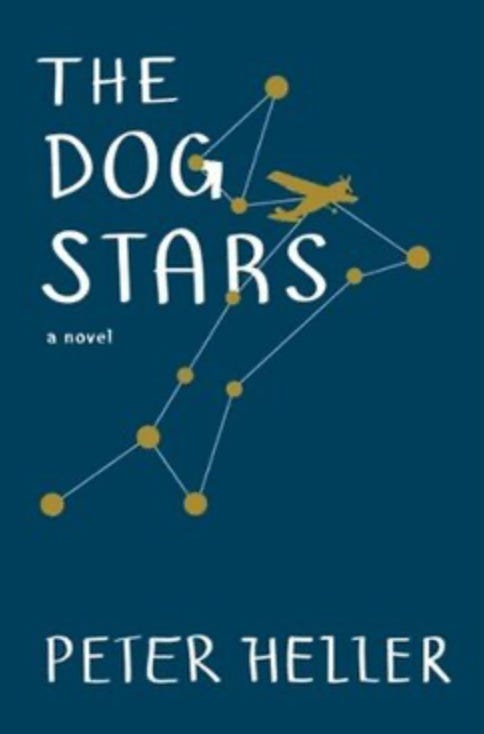
As the title suggests, I recently finished reading Peter Heller’s The Dog Stars, a 2012 post-apocalyptic novel set in the aftermath of a deadly flu pandemic, and recently adapted into a movie starring Josh Brolin, Jacob Elordi, and the one and only Margaret Qualley.
I discovered the novel because of the movie, and as I occasionally do, decided to read the source material before seeing the adaptation. Alas, I did not finish the book in time to see the movie in theaters as it appears to have more or less bombed despite a decent cast and Ridley Scott directing. I’ll catch it on streaming.
After reading the book, I can guess why it bombed though. It’s not really an action blockbuster or altogether really an apocalypse novel. I would imagine the movie going public is pretty burnt out on post-flu pandemic scenarios after Covid and a glut of associated programming over the last five years.
Despite all that, I am here to say that the novel was a deeply enjoyable and introspective exploration of grief and trying to move on in the face of it. It’s a novel, that like the best novels, you read for an emotional release. You read because the themes make you think. And ultimately, you feel some type of uplifted when you turn the final page.
Still, some nights I grieved. I grieved as much at what I knew must be the fleeting nature of my present happiness as any loss, any past. We lived on some edge, if we ever lived on a rolling plain. Who knew what attack, what illness. That doubleness again. Like flying: the stillness and speed, serenity and danger. The way we could gobble up space in the Beast and seem to barely move, that sense of being in a painting.
Heller, Peter. The Dog Stars (pp. 302-303). (Function). Kindle Edition.
This specific sort of edification you get out of good lit almost never translates well to the screen. It can, but you really have to know what you are making. And even then, it probably won’t be good for mass consumption. Something necessary to recoup a $110 million budget. Ultimately, I don’t think this novel was a good foundation for a summer blockbuster.
As you can tell from the subtitle of this review, An Apocalypse Cozy, this is not your average post-apocalypse novel. It’s not all guns and zombies. In fact, there are no zombies. It’s not 28 Days Later or I am Legend. And neither is it Cormac McCarthy’s The Road, although that is probably the closest thing I’ve personally read that lends itself to comparison. The Dog Stars is low-key. It’s a “hang out novel” in a world with not very many people left.
In the years preceding, a deadly flu pandemic has wiped out much of the population. The law of the land is the law of the jungle. Those that remain after the collapse of civilization exist amidst the ruins of crumbling infrastructure, fighting off roving bands of murderous scavengers.
The novel follows Hig who lives at the Erie Municipal Airport in Colorado with his dog Jasper, an aging and half deaf Blue Heeler. Bangley, a slightly sociopathic gun fanatic, is his partner of convenience. Hig is something of an everyman, formerly a Denver area contractor, whose hobbies included flying Cessnas, fly fishing, and hunting. Hobbies that turn out to be pretty helpful in a post-apocalypse scenario.
Over the course of the novel, Hig flies around in a Cessna he has aptly named The Beast, scavenging for supplies and spotting raiders from above. The relationship between him and Bangley is symbiotic. Hig patrols their perimeter as an early warning system. Bangley uses raiders as long distance target practice from a spotting tower they’ve built on the edge of their high plains fiefdom.
There are a few tense tangles with raiders, but the ease with which they mop them up is part of the reason I jokingly call it a cozy. It’s the apocalypse on lo-fi. None of this is a complaint either, because the book isn’t supposed to be a high-octane shoot ‘em up nor a nightmarish journey towards hope (somebody must carry the fire).
Instead, it’s a deeply introspective book about loss and loneliness. Hig can take care of business when he needs to, but it’s very clear he doesn’t like killing. He’s a gentle soul, and he entertains his better angels at his own peril. For example, he often visits a band of Mennonites with the blood disease, some type of autoimmune side-effect from the pandemic, in order to give them some of his surplus meat and vegetables. Of course, the visits aren’t necessarily about them. They are about Hig trying to fill a need for community. About him trying to fill a hole left behind by his late wife, and well, the rest of society.
As far as plot goes, the story is fairly straightforward and more or less character driven. There is a plot, but what I would classify as the inciting incident doesn’t happen until over a third of the way through the book. If you are looking for a post-apocalyptic romp and stomp then keep looking.
Spoilers Ahead.
Hig takes one of his trips to the mountains to fish and hunt and clear his head. In the middle of the night, Jasper quietly passes in his sleep. This is Hig’s breaking point and the moment that sets off the rest of the novel’s events.
I’d like to pause here to call out why the way Jasper dies is so important to the novel’s theme. He doesn’t die protecting Hig nor is he used as an especially tragic plot device to get our hero moving on a revenge arc. No, he passes away curled up next to his human, quietly passing from old age.
Dogs are man’s best friend. But the insanely cruel irony of this relationship, one that it is as close to unconditional love that human’s can get on earth—Dog’s only live ten or fifteen years. Sometimes less. Whether you keep getting dogs after the first one breaks your heart, is in my opinion, one of the truest tests of one’s capacity for life (& death) and love, even though you know that inevitably you’ll have to go through the “end” again. Is it worth it to you to have the good again? To have the good, you have to make peace with the bad.
The entire book is about our mortality. Our human frailty. The way everything we will ever love, will at some point, pass away. And the question posed by all of that, is how does one go on?
Hig reacts by clinging to a tiny dot of hope. After getting his head a tiny bit right and narrowly escaping a raider attack, he tells Bangley about a mysterious radio call he heard over the radio from Grand Junction’s Airport almost three years prior. He tells Bangley, that he has to go check it out. The only problem being that The Beast can only carry enough fuel to barely make it there, even with taking some extra gas in fuel cans (due to weight limits).
This trip to investigate a mysterious radio call that’s three years old is essentially a one way trip. It is a suicide mission with the hope of human connection as its prize. Bangley is somewhat sad to see him go, but sends him off knowing the Hig is going to entertain his better angels.
Hig is almost to Grand Junction when he spots a woman (hips and all) in the clearing of a small mountain ranch.
Short nod. Cima looked across the meadow, the canyon. If I were a painter—she was that beautiful. Maybe not her alone, but the moment. The green reflected darkly in her violet eyes, and I thought, If we crash and burn tomorrow morning, well.
Heller, Peter. The Dog Stars (p. 265). (Function). Kindle Edition.
He does another pass flying low and takes a windshield full of buckshot from her father. Hig is so enamored by the sight of a real live woman and the implications of feminine presence (maybe the possibility of love) that he lands The Beast and launches a light assault on the ranch. He manages to convince them with some clever signage and a bluff about grenades that he is only there to talk and share a meal and doesn’t want trouble.
Here, Hig finds his new reason to live. After a tense few days of feeling each other out, Hig makes fast friends with the lovely and gentle Cima and her gruff dad who Hig only refers to as Pops. They feed him and he helps in the garden and with the sheep. Slowly, he and Cima form a romantic relationship. Pops is quite ironically the same exact dude as Bangley. He is a former operator and something of a misanthrope with a heart of gold and no problem killing. Hig has a funny way of stumbling into this sort of partnership.
Why’d you come here? he said simply.
Didn’t answer. Not defensive, not reticent, I just didn’t know. Not really.
You got in your plane and flew past your point of no return. In a world maybe without any more good fuel. You left a safe haven, a partnership that worked. For a country that is not at all safe, where anyone you meet is most likely going to try to kill you. If not from outright predation then from disease. What the fuck were you thinking? Hig.
My dog died, I said.
Heller, Peter. The Dog Stars (p. 217). (Function). Kindle Edition.
However, not all is perfect in paradise, the ranch is dying due to drought and Pops and Cima have been slowly making peace with the fact that they need to leave and look for somewhere else. The answer to this problem lies with Hig and The Beast.
Hig agrees to take them in The Beast to refuel in Grand Junction for the return trip to Erie. This sets off the events of the climax and ultimately the novel’s conclusion. Events I won’t spoil here. I will say the climax and subsequent end of the book are both quite satisfying even if hair raising.
Conclusion.
If you are looking for Jim Harrison’s version of The Road, then this probably gets pretty close. I found some the prose a bit tortured. Where Harrison and McCarthy make their genius look effortless, Heller at times feels like he’s trying to write something beautiful. Sometimes it lands, sometimes it doesn’t. That is my only tiny grumble and it could also be a taste thing. I am but a humble enjoyer of literature. Overall, I loved this book. I give it an easy five stars and put it somewhere in my top twenty. It was a book that my soul needed. In fact, I’m tempted to read it again.
My favorite poem, the one by Li Shang-Yin:
When Will I Be Home?
When will I be home? I don’t know.
In the mountains, in the rainy night,
The Autumn lake is flooded.
Someday we will be back together again.
We will sit in the candlelight by the West window.
And I will tell you how I remembered you
Tonight on the stormy mountain.
— Heller, Peter. The Dog Stars (p. 312). (Function). Kindle Edition.
Never heard of the film or book. Solid review here. Thanks.
Outstanding review. Sincere thanks for posting. The only other thing I’d add beyond what I restacked was that I enjoyed the first half of the book more than the second. Like, a good bit more. I loved Hig’s relationship with Bangley and Jasper, and also very much appreciated how Heller’s treatment of the dog dying. Ultimately, I thought there was a missed opportunity to say more in the back half about what foster relationships (for lack of a better term) do for men in their lives than what ended up on the page. It was there with Cima and Pops, I just think there could’ve been more done to show the advantages and drawbacks and how those “replacement” relationships impact our lives as men. It’s what helps us let go, love again, etc.