

I have a sneaking suspicion that most fans of men’s adventure, westerns, and war fiction are also fans of memoir and autobiography, and if they aren’t, its likely just because they don’t know about all the cool shit out there. I’m using the term memoir a bit loosely here, and including autobiographies as well. First hand accounts are fascinating for the same reason the Coen brothers used the fictional disclaimer “Based on True Events” at the beginning of Fargo. But with memoir and autobiography, what you learn is that truth is often stranger, and often more exciting, than fiction. So without further ado, here are five that I’ve read recently and quite enjoyed.
The Life and Adventures of Billy Dixon

I quite enjoyed this book. It is a memoir written by Billy Dixon’s late wife Olive K. Dixon. She essentially interviewed her husband during the last years of his life and on his deathbed, transcribed his life story, and then more or less self published it. That we may all have wives like this.
This book is short, but jam-packed with funny anecdotes about buffalo hunting and life on the plains. It really puts into perspective that men have always been the same. Cracking jokes with the boys, playing pranks. A work hard, play hard attitude runs deep.
Billy is best known for his role at the Second Battle of Adobe Walls, where he and ~30 other buffalo hunters held off a confederation of Comanche, Arapaho, Kiowa, and Cheyanne that was close to 1000 strong. Billy would go on to win the Medal of Honor for his actions at the Buffalo Wallow Fight a few years later, while working as a scout for the US Army. He is one of the few civilians to ever receive the medal.
I actually adapted this book into a screenplay last year. So Paramount, hit me up! At some point I may turn the screenplay into a novella or release it on here just for heck of it, but it was good practice and is a fascinating story.
Rising Wolf the White Blackfoot
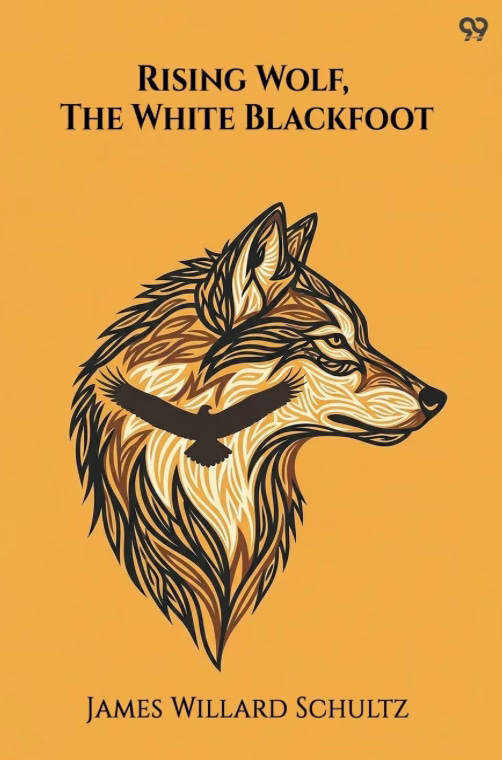
This is a somewhat fictionalized account of Hugh Monroe, a trapper and trader and father in-law to the author, who lived among the Blackfoot while working for the Hudson’s Bay Company. He lived with the Blackfoot from 1814 to 1815 in order to learn their ways and their language.
This book is not exactly action packed but is just a riveting first/second hand account of living with the Blackfoot in the very early 1800s. It also helped inform much of the world of Medicine Woman.
Below is a cool anecdote about the indians keeping two bear cubs as pets and fairly par for the course when it comes to interesting bits of the book.
We got down from our horses, and I was about to unsaddle mine, when a woman took him from me, and signed that I was to follow the chief into the lodge. I did so, and, making a step in through the doorway, heard a growling and snorting that made my heart jump. And well it might, for there on each side of me, reared back and hair all bristled up, was a half-grown grizzly bear!
I dared not move, neither to retreat, nor go forward, and thus I stood for what seemed to me hours of time, and then Lone Walker scolded the bears and they dropped down at rest and I passed them and went to the place pointed out to me, the comfortable couch on the left of the chief’s.
I think that the chief allowed me to stand so long facing the bears, just to try me; to learn if I had any nerve. I was glad that I had not cried out or fled. I soon became friendly with those bears, and often played with them. It has been said that grizzlies cannot be tamed. Those two were tame. They had been captured when small cubs, so small that they made no resistance to being taken up, and for months had been held up to the teats of mares, there to get the milk without which they could not have lived. I may say here that they disappeared one night in the spring of their third year, and were never seen again. They had at last answered the call of their kind.
Schultz, James Willard. James Willard Schultz Collection (Annotated): Bird Woman (Sacajawea) the Guide of Lewis and Clark, Lone Bull’s Mistake, Rising Wolf the White Blackfoot and Apauk, Caller of Buffalo (p. 305). (Function). Kindle Edition.
Three Years With Quantrill: A True Story Told By His Scout
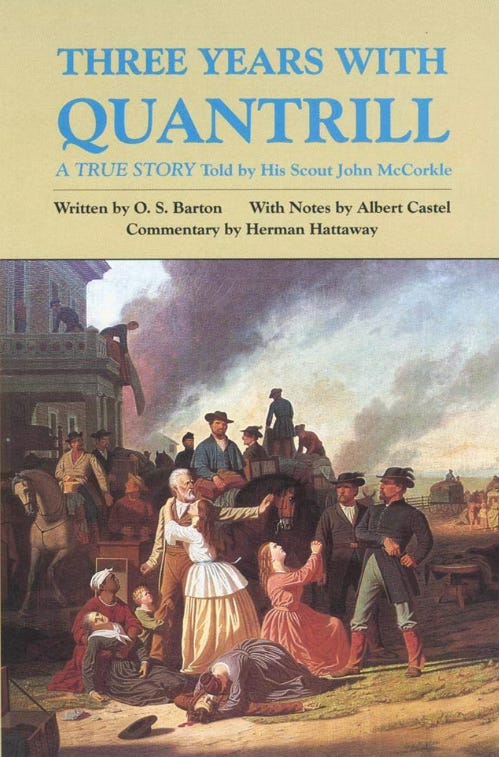
This is the memoir of John McCorkle, one of Quantrill’s scouts. This book like The Life and Adventures of Billy Dixon is also filled with humorous anecdotes. These old rogues loved to laugh. But seriously, fascinating read if one is interested in the Missouri bushwhackers or a fan of The Outlaw Josie Wales. Its also impossible to read and not come away with the idea that Quantrill was likely not the monster he was made out to be by the Union and was actually a fairly honorable leader.
The Outlaws
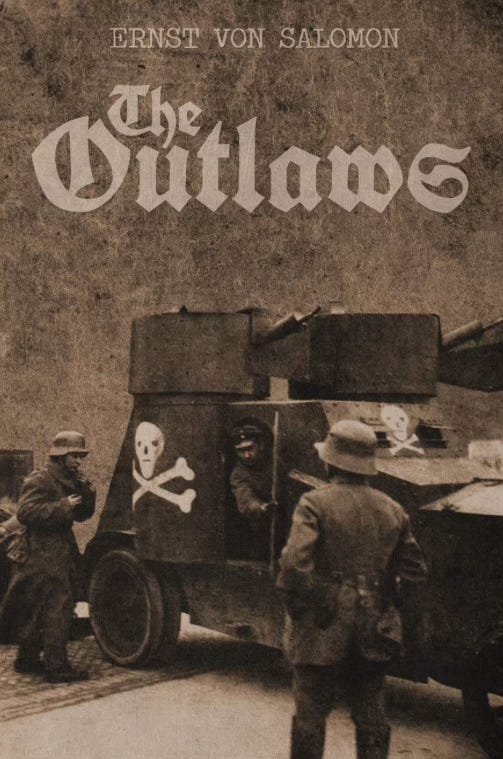
This book was pretty good. A bit hard to follow at times as it follows the Freikorps during the Weimar Republic, and I wasn’t particularly aware of a lot of the history it seemed to be referencing. It’s also somewhat fictionalized, but not clear how much. Lots of bloody commie killing action and a very interesting look at the ennui felt by veterans of WW1 as they dealt with losing their country and culture. A good enough read, but probably a one time thing for me.
Blurb below for those interested.
It is November 1918. Germany has just surrendered after four years of the most savage warfare in history. It is teetering on the brink of total social and economic collapse, and the German people now lie at the mercy of new, liberal politicians who despise everything Germany once stood for. The Communists are rioting in the streets, threatening to topple the new government in Weimar and bring about their own revolution. The frontline soldiers are returning from the hell of the war to find an unrecognizable land, the principles and traditions they had sacrificed so much to defend now the stuff of mockery. The narrator of The Outlaws, a 16-year-old military cadet, is too young to have served in the trenches, but feels the sting of this betrayal no less than they. Since Germany’s armies have been all but disbanded, he joins the paramilitary Freikorps – groups of veterans who refuse to lay down their arms, and who have pledged to stop the Communists – and begins fighting, first in the streets of Germany’s cities, and then in the Baltic states, defending Germany’s eastern frontiers from Communist subversion while ignoring the calls to disengage by the meek politicians at home. After months of intense fighting abroad, the Freikorps soldiers return to settle scores with their enemies in Germany, dreaming of a nationalist counter-revolution, and, their trigger fingers still itchy, fix their sights on bringing down the hated new government once and for all…
The Outlaws is a chronicle of the experiences of the men who fought in the Freikorps, but it is also an adventure and a war story about an entire generation of soldiers who loved their homeland more than peace and comfort, and who refused to accept defeat at any price.
“What we wanted we did not know; but what we knew we did not want. To force a way through the prisoning wall of the world, to march over burning fields, to stamp over ruins and scattered ashes, to dash recklessly through wild forests, over blasted heaths, to push, conquer, eat our way through towards the East, to the white, hot, dark, cold land that stretched between ourselves and Asia – was that what we wanted? I do not know whether that was our desire, but that was what we did. And the search for reasons why was lost in the tumult of continuous fighting.” — p. 65
Ernst von Salomon (1902–1972) was one of the writers of the German Conservative Revolution of the 1920s. Like the narrator of The Outlaws, he was a military cadet at the end of the First World War, and joined the Freikorps, participating in many of the events described in the book, including the assassination of Foreign Minister Walther Rathenau, for which he was imprisoned. He went on to write many books and film scripts.
The Last Ivory Hunter: The Saga of Wally Johnson
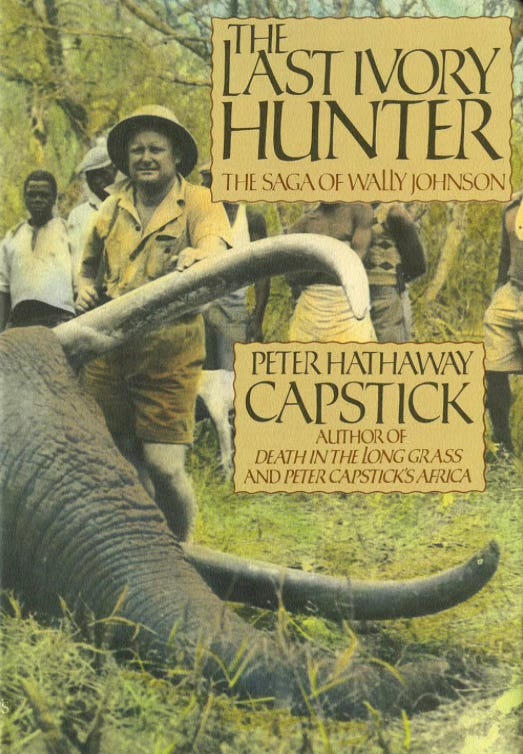
No list like this would be complete without a little Peter Hathaway Capstick. And in this case, I saved the best for last.
Capstick, an excellent writer and big game hunter, chronicles the life of African legend and ivory hunter Wally Johnson. Much of the book is in Johnson’s own words, as Capstick sat down and interviewed Wally for the book.
Wally truly lived a life of adventure, hunting elephants for ivory, gold mining, and even trying his hand at an almost cursed attempt at growing bananas. This is a look at a much wilder turn of the century Africa. The book is jam-packed with hunting stories, deadly encounters with snakes, lions, tuskers, and then finally communists.
The last quarter of the book takes a very shocking turn as Mozambique is taken over by a Communist uprising. Wally’s farm and gold is stolen by revolutionaries and he is kicked out of the country he called home for his entire life.
It’s a hell of a story and has a hell of a lot of good fiction fodder. There’s definitely a John Wick/Sisu story to be written about a big game hunter picking off communists in the bush. Maybe, I write someday.
Blurb below for those who need more selling.
A chance meeting around a safari campfire on the banks of the Mupamadazi River leads to The Last Ivory Hunter: The Saga of Wally Johnson, a grand tale of African adventure by renowned hunting author Peter Hathaway Capstick.
Wally Johnson spent half a century in Mozambique hunting white gold—ivory. Most men died at this hazardous trade. He’s the last one able to tell his story.
In hours of conversations by mopane fired in the African bush, Wally described his career—how he survived the massive bite of a Gaboon viper, buffalo gorings, floods, disease, and most dangerous of all, gold fever. He bluffed down 200 armed poachers almost single-handedly, and survived rocket attacks from communist revolutionaries during Mozambique’s plunge into chaos in 1975.
In Botswana, at age 63, Wally continued his career. Though the great tuskers have largely gone and most of Wally’s colleagues are dead, Wally has survived. His words are rugged testimony to an Africa that is now a distant dream.— Backcover blurb

Love this thanks I’ll look into one or two my list is growing !
Looks like some good nonfiction reading. Thanks for the tips.