


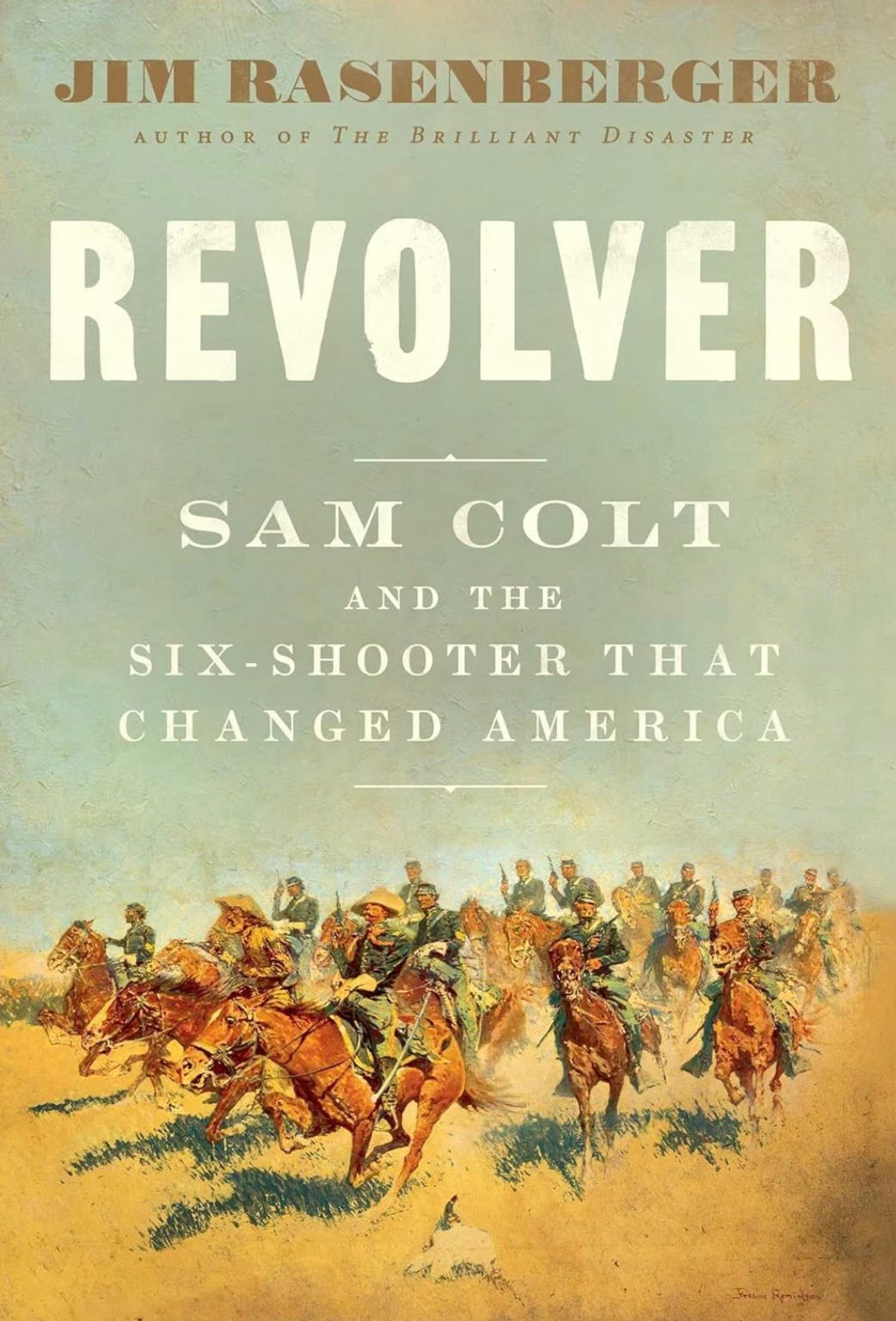
This is both book review and pitch. Like Elon Musk, I too believe in turning my good ideas loose into the world. So hopefully some big time producer somewhere reads this and steals the idea. Or maybe when I finish with one of my million other projects I’ll sit down and write a pilot and a series bible in about ten years.
Regardless, many know that Samuel Colt invented the revolver, so foundational to the American Founding Myth, that Samuel Colt closely follows God in its telling: “God created men, Col. Colt made them equal.” Very American—this idea of the gun as perfection of God’s handiwork. What you don’t know is how that story unfolded.
If you read Empire of the Summer Moon by S.C. Gwynne you might have a better idea. It was this book and its description of the Texas Rangers and the revolvers pivotal role in defeating the Comanches that first turned me on to this story. And so I went looking for a second book that would expand on Colt and his life, and that book was Revolver: Sam Colt and the Six-Shooter that Changed America by Jim Rasenberger.
Colt’s story is of a man, and subsequently a company, that is about as archetypally American as apple pie. And not just because of his involvement with firearms. Colt is in a lot of ways an early prototype for every eccentric entrepreneur and startup founder we have running around today. His philosophical DNA lurks in Musk, Altman, Bezos, and Zuckerberg. He was a bit businessman, a bit showman, a bit grifter, and a bit mad genius. Always on the hunt for an angel investor and always on the run from those who’d already invested. The story of Colt and his revolver is the story of American Industry.
Early Life (no not that kind, chill)
Samuel Colt was born in 1814 to Sarah and Christopher Colt of Hartford, Connecticut. Samuel Colt was one of eight children and the third youngest. His father, Christopher Colt, was a merchant and made most of his wealth off of the buying and selling of ship’s consignment. However, he went bankrupt in the Panic of 1819. Unfortunately, that was not the last of the family’s troubles. Two years later, and just before Sam’s seventh birthday, his mother died of consumption.
I’ll add here, that one of the things you start to notice when reading history or biographies in general is just how quickly fortunes could be made or lost. How quickly and suddenly loved ones could pass away. Life is truly ephemeral, and it’s not clear that we moderns have benefitted from the lack of reminders. I always find myself impressed by the grit and perseverance on display by our ancestors. Granted, there really is no other option. Life goes on and one either picks up and tries again, or suicides. But still, it’s a nice reminder of just how resilient the human animal is.
But I digress. Colt was a boy born of the fabled Industrial north. In 1829, Colt, now 15 years old, along with the rest of his family all moved to the town of Ware. Ware was like so many other New England towns, a factory town, revolving around a massive textile mill that took advantage of a nearby river and the massive drop an elevation. Steam powered factories were still new at the time, and Ware was of an older sort.
By all accounts, Colt was a precocious boy obsessed with science and invention and little is known about Colt’s life from this time, save for one anecdote:
Incident at Ware Pond
The fifteen year old Colt, in the days leading up to the town’s Fourth of July celebration, had advertised around town that he would blow up a raft on Ware pond.
Colt never left a record of how he carried out his demonstration, so his exact materials are not certain, but he had at least three items with him: a long copper wire, waterproofed with cloth and tar and probably spliced in the middle with a strip of filament; a waterproofed container packed with gunpowder; and an instrument to produce an electrical charge, most likely a simple Leyden jar, a glass vessel covered in foil and filled with water, which stored enough static electricity to generate a spark.
Rasenberger, Jim. Revolver: Sam Colt and the Six-Shooter That Changed America (pp. 28-29).
Colt set his gunpowder on the raft, hooked up the cabling and sent it out into the pond. With a massive crowd of spectators looking on, he hooked the cable to his Leyden jar, completed the electrical circuit and exploded the raft. The crowd, quite the opposite of being amazed, was incensed at being doused in the brackish waters of Ware pond and descended on Colt, who was led quickly away by his friend Elisha Root.
Colt’s life is dominated by these sorts of demonstrations. Incredible ideas that either fall flat or are in some ways too advanced for anyone else to grasp the significance of them.
Colt would go on to be kicked out of Amherst boarding school for stealing a cannon with several other schoolmates and firing off a steady volley of shots on another July 4th in Massachusetts.
When a professor named John Fiske—one of the school’s trustees—marched up the hill and demanded that Colt cease fire, Colt “swung his match, & cried out, ‘a gun for Prof. Fiske,’ & touched it off. “The Prof. enquired his name—& he replied, ‘his name was Colt, & he could Kick like Hell’ ” The story of Colt and the cannon had often been repeated in Amherst over the years, Dickinson informed Barnard, but until the biographer’s inquiry Dickinson had never realized that “the celebrated Hartford Sam Colt, was the hero of that occasion.” In any event, wrote Dickinson, “He soon left town, for good.”
Rasenberger, Jim. Revolver: Sam Colt and the Six-Shooter That Changed America (p. 33). (Function).
It was this most recent debacle that led to Colt being expelled or pulled from Amherst and sent aboard the Corvo as a sailor.
Legend has it, that it was here where Colt first had his idea for a gun with a revolving cylinder. Colt whittled the first proto-type revolver on the return voyage, after watching either the ship’s wheel, or its windlass, revolve in place.
However, more interesting than this apparent beginning is an incident earlier in the voyage, where a sixteen year old Colt is accused of stealing food from the ship’s stores and subsequently flogged.
If we accept the findings of Captain Spalding and take Colt’s guilt at face value, the whole episode raises at least two questions regarding his character, neither of which can be answered definitively. First, how much weight should be given to his thievery? Should it be viewed as a foolish but forgivable transgression by a miserable sixteen-year-old boy looking for treats to soothe himself? Or did it indicate a larger moral flaw? Not knowing all the facts, the best course might be to give young Sam the benefit of the doubt, for the same reason that most legal systems purge the misdemeanors of minors: we recognize that youths should not be held to the same standards as adults. We give him a pass, in other words, and rule his crime inadmissible in our estimation of him as a man. Of course, that is more easily said than done. Once we know Colt stole, we cannot unknow it.
If the first question is whether Colt’s actions reflect some essential flaw in his character, a second question is what effect the episode had on him. Dana portrayed the men whipped aboard the Pilgrim as profoundly damaged, skulking about afterward like shadows of their former selves. That does not seem to have happened to Colt. On the contrary, he seems to have drawn power from the experience, fortifying his resolve to serve no master but himself.
The flogging was never mentioned by Colt. It was obliterated from all records of his life. The only document naming him as a thief who was flogged was a single page of a missionary’s journal that would end up in the archives of the Presbyterian Church in Philadelphia. Surely at some moments, though, Colt removed his shirt in the company of another person—the woman he married, for example—and revealed the faint pink stripes on his back. The scars of flogging lasted a long time.
Rasenberger, Jim. Revolver: Sam Colt and the Six-Shooter That Changed America (pp. 45-46). (Function).
Unlike most biographies where the Early Life is largely devoid of character and typically the most boring part, Colt’s is swimming with capital C character moments, drama, and adventure. Lots there for a show runner to mine for flashbacks or a pilot episode.
Back from his voyage aboard the Corvo, Samuel Colt would spend the next two years as something of a circus freak. He would go on tour with a portable science lab in which he would go from town to town giving demonstrations of nitrous oxide also known at the time as laughing gas. During this time, and using the proceeds from his nitrous oxide hustle, he commissioned a gunsmith to start making models of guns that utilized a rotating chamber and were capable of firing through a singular barrel. Eventually, Colt would find a gunsmith up to the job, a man named John Pearson, who would be pivotal in bringing the inventions to life. It would not be until 1835 that the models advanced enough for Colt to file a patent, but before he filed one in the United States, he would have to travel to Europe in order to file one in both the Great Britain and France (a filing in the US would preclude a patent in Great Britain).
The next ten years would largely be dominated by failure, dipping out on creditors, and bankruptcy.
The Legend
Colt tried for years to sell his revolver to the U.S. Army, largely failed, and then went bankrupt because the Generals in Washington thought the side-arm too disruptive too their current battle tactics. Armies at the time mostly marched in ranks and met on open fields of battle. Infantry used single-shot muskets, stood in lines, and achieved steady fire by ranks of soldiers firing in sync.
But—not every one saw things this way. Indian fighters, whether US Army or not, all immediately grasped the usefulness of a gun that fired repeatedly. Because of this, Colt’s initial models found some minor use at the tail end of the Seminole War, and then again by the Texas Republic’s Navy (yes, Texas had a Navy).
And it was this latter purchase that eventually catapulted Colt to success. Some of these revolvers purchased by the Texas Navy fell into the hands of the Texas Rangers who were having their numbers halved by Comanches each year.
Comanches fought mounted and could fire off arrow after arrow in quick succession. The rifle was a technological advancement over the bow for sure, but only for its first shot. In a fast moving fight with little time to reload, the single-shot rifle or musket quickly regressed back to the Stone Age and became little better than a club, at least until it could be reloaded again. But when reloading took upwards of a minute, its owner would already be full of arrows.
Enter the revolver:
Scene: In 1844, fifteen Texas Rangers, newly equipped with surplus .36 Colt Paterson revolvers taken from storehouse after the Texas Navy disbanded, find themselves in a running fight with over seventy-five Comanches.
Cut to: A bankrupted Colt trying to hawk naval mines. The factory for revolvers lies dormant and empty. The machinery and tooling all auctioned off to pay off creditors.
Back to Scene:
“They [Comanches] expected the rangers to remain on the defensive, and to finally wear them out and exhaust their ammunition. The rangers ran close beside them and kept up a perfect fusillade with pistols. In vain the Comanches tried to turn their horses and make a stand, but such was the wild confusion of running horses, popping pistols, and yelling rangers, that they abandoned the idea of a rally and sought safety in flight. Some dropped their bows and shields in trying to dodge the flashing pistols. The pursuit lasted three miles, and many Indians were killed or wounded.”
- Andrew Jackson Sowell
As mentioned before, Colt had already gone bankrupt and had no way of manufacturing revolvers anymore. He had already started a new company that was trying to pitch electrically detonated naval mines to the US Department of War with the help of Samuel Morse (the inventor of the telegraph). The incident at Wade pond seems to have been the originating idea for this latest hustle.
But that was soon to change. Samuel Hamilton Walker, a Texas Ranger, would write Colt about the Ranger’s new found success and then offer his feedback to make the revolver a bit more deadly against Comanches. Walker would then go on to help Colt design his next model. He would also become the champion of the Colt revolver to skeptical brass in Washington.
Walker, a decorated Texas Ranger, and hero of the Mexican America War, brought with him a hefty amount of clout. Additionally, Eli Whitney would help Colt design new tools for the gun’s manufacture. And eventually, this new weapon, made to the specs that Walker recommended, would be dubbed the Colt Walker, or the Walker Colt, and be chambered in .44, weigh in at 4.5 lbs, and sport a nine inch barrel.
It was a firearm designed for one purpose, to punch a hole through thick buffalo-hide shields and blow away the Comanche that stood behind them.
“We come now to the first radical adaptation made by the American people as they moved westward from the humid region into the Plains country. The story of this adaptation is the story of the six-shooter, or revolver.
- Walter Prescott Webb
The rest is history. The Colt revolver, in the years that followed, would first and foremost be adopted by the frontiersmen, the homesteader, the cowboy, and the Indian fighter. The US Army would tentatively adopt the revolver, as a sidearm for field officers and it would go on to see limited use by cavalry, but the Army still would not commit to the tactical changes it required to effectively integrate it as a battlefield staple.
We can see this beauracratic inertia, or even obstinance, lasting all the way up to and through most of the Civil War. And by this point, the introduction of the repeating rifle negated the revolver in military matters. It would be the repeating rifle that finally changed formalized war, but it was the revolver that paved the way.
The Civil War in the West (Missouri and Kansas) is marked by bloody guerrilla warfare waged by the very same men that would go on to be western legends such as Cole Younger and the James brothers. These guerrillas fought against Union Troops that were typically armed with nothing but muskets or single-shot rifles. The Missouri guerrillas or bushwhackers as they were often called, sporting long hair, draped in pistols, scalps braided into bridles, fought mounted, and their weapon of choice—the revolver.
Many a story from these engagements starts with a band of guerrillas baiting a much larger union troop into firing on them (to expend their single shots), and then riding hell for leather down on them, their revolvers sparking, before squad-wiping most of the infantry frantically trying to reload.
This specific instance isn’t directly mentioned in the text at hand, but as I’ve been on a Missouri Guerrilla kick, the story of the Colt Revolver has helped slide some other bits of history into sharper focus.
And this is where you start to grasp how mythically American a lot of this. Private citizens adapting disruptive technology and using it to carry civilization forward, while Government and bureaucracy struggle to keep pace.
That’s a good theme for a biopic.
Eventually, things do change. Technology does get adapted. But it takes a long time to be integrated at the institutional level, an important thing to keep in mind as we approach the 20 year anniversary of bitcoin and are now only a few years into “AI.”
The American System of Manufacture
The revolver would of course become a staple of life in the West, and Samuel Colt would go on to become very rich from it. He would perfect the American System of Manufacture.
By the time the exhibition [Great Exhibition of the Works of Industry of All Nations which would become known as the first World’s Fair] closed on October 11, 1851, the weather had turned cold and rainy and the roof of the Crystal Palace had sprung a few leaks—it really was just a building after all. The entire structure would now be dismantled and moved to Sydenham Hill, in south London, where it would serve as a museum until destroyed by fire in 1936.
The ephemerality of the Crystal Palace notwithstanding, the exhibition had been a transformative event, not just in England, but in the United States, where the acclaim for American products stimulated national pride. The newly enormous nation was evidently as inventive and brilliant as it was large. “Recently America has been put to the test,” boasted one US publication. “But how does the race come out? As no human mind could have anticipated. The trial gives America the command of all the great interests of life.”
When the exhibition prizes were announced in October, the United States won a disproportionate number. McCormick, Goodyear, and a Texan named Gail Borden who had created a dried-meat biscuit (and would later devise his more famous condensed milk) all won medals for original design. Much to the surprise of the American contingent, Colt received only honorable mention for his pistols. Some suggested this result owed more to the influence of the British gun industry than to an honest appraisal by the judges. The gold medal went to a British inventor of a repeating arm named Robert Adams.
The prize that mattered most was public opinion, however, and here Colt prevailed. In early November, British Army Despatch published a glowing and passionate review of Colt’s guns, urging them for use in the British military, especially in its many colonial outposts. “We cannot help expressing our opinion that whoever would deny this weapon to be a valuable auxiliary in anything like irregular warfare, must be either the victim of delusion, or, what is far more difficult to remove, old-fashioned prejudice and antipathy.” Another publication, the Spirit of the Times, called for the deployment of Colt’s revolvers in South Africa. “They make one man equal, in short, to many, and strike fear into the hearts of savages.”
The greatest honor of all came on November 25, when Colt delivered an address to the Institution of Civil Engineers in London. He was the first American ever invited to speak before this august body of British engineers and scientists. In attendance were also a number of prominent Americans stationed in London for various reasons, including Abbott Lawrence, the wealthy textile manufacturer and esteemed benefactor of the Lawrence Scientific School at Harvard, now serving as US minister to Great Britain. Abbott was the older brother of Samuel Lawrence, the friend of Christopher Colt’s who had many years earlier delivered Sam to the Corvo.
Colt’s talk was titled “On the Application of Machinery to the Manufacture of Revolving-Breech Firearms.” He began by discussing prior examples of multifiring guns, wisely wrapping himself in the history of the revolver rather than denying it. He showed some drawings of previous attempts at repeaters that he had discovered in the Tower of London, including a fifteenth-century matchlock with a four-chambered revolving cylinder. The main point of his history lesson was not to praise his predecessors, but to point out that no one had fully succeeded until he came along.
Colt tended to tailor the story of his gun’s origin to the audience he was delivering it to, and he did that now. He claimed that he invented the revolver because he lived in a country “of most extensive frontier, still inhabited by hordes of aborigines.” Inspired by “the insulated position of the enterprising pioneer, and his dependence, sometimes alone, on his personal ability to protect himself and his family,” he had frequently “meditated upon the inefficiency of the ordinary double-barreled gun and pistol, both involving a loss of time in reloading, which was too frequently fatal.”
In fact, Colt had not developed the revolver with pioneers and aborigines in mind—they became pertinent to him only later—but he understood the appeal of this story to English imaginations. Not only did John Bull love tales of the wild American west, he was at that moment particularly interested in weapons to use against aboriginal populations in colonial outposts.
It took a while for Colt to warm to the true subject of his talk, which was not guns but machines. He wanted his audience to understand that his machines and his production methods were every bit as significant—as revolutionary—as his revolver. After chiding the English for continuing to make guns largely by hand, he introduced his audience to what would soon come to be known as the American System of manufacturing: “In America, where manual labor is scarce and expensive, it was imperative to devise means for producing these arms with greatest rapidity and economy.” Machines required less labor, saved costs, and, perhaps most important of all, helped achieve uniformity. Four-fifths of the work at Colt’s factory was now performed by machines, he told his audience. He had broken his gun down into the fewest possible parts (the lock had previously required seventeen components, for example, and now had just five), then replicated each of these parts by a machine dedicated to it alone.
In fact, all the separate parts travel independently through the manufactory, arriving at last, in an almost complete condition, in the hands of the finishing workmen, by whom they are assembled, from promiscuous heaps, and formed into firearms, requiring only the polishing and fitting demanded for ornament.… By this system the machines become almost automatons.
When Colt was done, a few men in the audience rose to defend British industry, but most extolled Colt’s revolver. At one point, Robert Adams, Colt’s British rival and winner of the gold medal at the Crystal Palace, took the floor to describe the merits of his own gun, but several of his countrymen stood to say they did not think much of it in comparison to Colt’s, and Adams quietly resumed his seat. Then a Mr. May stood to object that a discussion about the merits of guns was not a proper subject for the society. He urged everyone to get back to the topic advertised by the title of the speech, which was machinery. Before sitting, Mr. May shared that he was Quaker and believed that all weapons should be dispensed with, “except for protections against wild beasts.”
Rasenberger, Jim. Revolver: Sam Colt and the Six-Shooter That Changed America (pp. 286-288). (Function).
Colt would go on to dominate the gun manufacturing industry in America for the next twenty years, periodically having to defend his patents from other companies. Colt would also sell guns to anyone, something he eventually caught a lot of grief for in the American Civil War, where the Colt company sold guns to both the Union and the Confederacy.
Colt’s death would come in 1862 by complications caused by gout. At the time of his death, his estate was estimated to be worth about 15 million dollars (about $472M adjusted for inflation). The estate was willed to his wife and son.
In conclusion
If you’ve read this far you no doubt see what an interesting biopic this would make. Colt and his invention touched a lot of history. He was both madman, huckster, and visionary. Texas Rangers, Seminoles, Comanches, Napoleon, and World’s Fairs all play a role in this man’s life. In one sense it’s the story of America, its manufacturing, its people, and the tools it used to conquer a continent, and then the world. I recommend the biography by Rasenberger. I simply did not have time to mention or cover much of the most interesting parts of his life. There is a movie moment happening on damn near every page. It’s for this reason that I think a limited series would be the best format. Something with lots of room for subplots and sidebars.
A true crime aside on John C. Colt
One such subplot, which I didn’t have room for here is in regards to John C. Colt, Samuel Colt’s older brother. Known for inventing double-entry bookkeeping, he would be famous for an especially grisly hatchet murder. The murder itself was highly publicized at the time and went on to inspire a story by Edgar Allen Poe. Before he could be hung, John C. Colt “died” from a fire that broke out in the prison after a conspicuously timed visit from his pyrotechnic magician brother Samuel Colt. This led to several conspiracy theories that John never died, but escaped with the help of his brother. I’ll let you decide.
What a fascinating biography. I don't watch much TV, but a Colt biopic would interest me. I enjoyed the article. Thanks for an "early life" section done right.
I didn't know Samuel Colt had such a colorful history, so yes, a biopic would be fun. On the more serious side, his introduction of interchangeable parts revolutionized manufacturing. What worked for his revolvers got applied to everything, paving the way to mass production. Imagine the cost of a hand-built car, every pushrod, gear, and manifold fabricated by hand.