


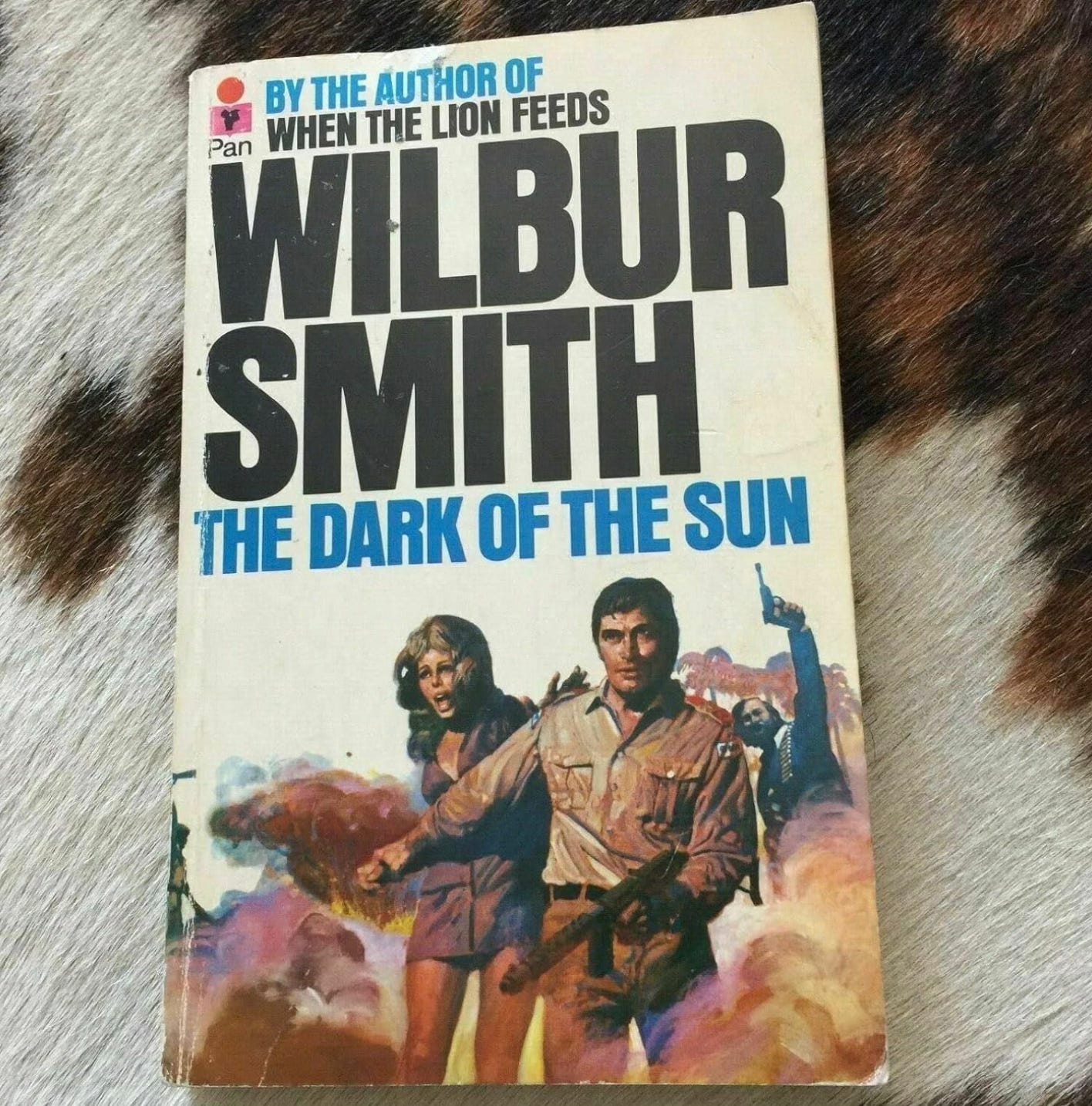
First off this novel rocked. My first and only experience with Wilbur Smith up to this point was When the Lion Feeds (check out the TFABS episode). While When the Lion Feeds is the first in the Courtney Saga series, this novel is a stand alone.
The Dark of the Sun is an old fashioned, no holds barred merc thriller set during the Congo Crisis. Captain Bruce Curry, a hardened mercenary, leads a ragtag band of mercs and a small army of Belgian Legionaries on a train mission through rebel-held territory. Their official mission: rescue colonial settlers from Simba rebels in a besieged mining town. However, this being a merc thriller means the boys aren’t running a humanitarian charity. The real mission is hauling out millions in uncut diamonds for the Congolese president. What starts as a straightforward (if dangerous) run turns into a nightmare of ambushes, betrayals, torture, and a hair raising encounter with cannibals.
Perhaps most interesting is the personal flaws and demons that two of the main characters are battling. Curry, himself has decided that if he refuses to let anyone get close than he can’t be hurt again. This is on account of a broken heart. His wife divorced him and took the kids. We are left to assume the separation was fairly bitter although Curry never gets overly detailed. This can at times feel a little bit discordant with what you might expect from a Mercenary in the bush. Curry’s way of dealing with this fairly pedestrian tragedy (a divorce) is pretty juvenile and a bit dramatic. On one hand if you think about it for too long it can come off a bit silly, but Smith is nothing if not a master at channeling pathos, and dudes are for the most part giant wimps when it comes to healing broken hearts despite the airs they put on to pretty much everyone but their closest friends. However, for the purposes of fiction, sometimes realism itself threatens the verisimilitude of genre. While most people use that word to describe fiction that doesn’t ring true to life, I actually think the magic of writing genre fiction works in the other direction. Where real life often breaks genre convention and character archetypes. Which is a long way to say I very much liked it, but could see others poking fun or not buying in.
Along for the ride is Mike Haig, a former surgeon, now turned mercenary who has an especially tragic backstory. Haig’s fatal flaw is alcohol. He is a recovering alcoholic and refuses to touch a drop but still struggles massively with the temptation. His alcoholism ruined his esteemed medical career when he killed a patient while operating underneath the influence. His wife, loyal woman that she was, stuck by him. They both moved to a farm in Africa to escape the media and shame of his malpractice. Soon his wife is pregnant. He goes into town for supplies but falls off the wagon and gets blasted drunk in a bar. By the time he gets home it starts to storm furiously, causing significant flooding so that the roads are all washed out or underwater. The shock of seeing him drunk again sends her into early labor. But of course there are complications and he’s drunk as a skunk. His wife begs him to operate but he refuses on account of being black out. Both her and the child dies. Haig’s recounting is one of the most gut wrenching things I’ve ever read. Again, Smith’s writing superpower seems to be channeling pathos.
‘I suppose it was the shock of seeing me like that again, but in the morning Gladys went into labour. It was her first and she wasn’t so young any more. She was still in labour the next day, but by then she was too weak to scream. I remember how peaceful it was without her screaming and pleading with me to help. You see she knew I had all the instruments I needed. She begged me to help. I can remember that; her voice through the fog of whisky. I think I hated her then. I think I remember hating her, it was all so confused, so mixed up with the screaming and the liquor. But at last she was quiet. I don’t think I realized she was dead. I was simply glad she was quiet and I could have peace.’
Smith, Wilbur. The Dark of the Sun (pp. 34-35). (Function). Kindle Edition.
Rounding out the main crew of mercs is Ruffo, an African man who is obsessed with beer. He is loyal to Curry and dependable.
The fourth member of the posse is Wally Hendry, also British(?), who is something of a psycho with a serious sadistic streak. Hendry is a merc because it allows him to live out his most base desires—plunder, rape, and killing.
Hendry’s true character is revealed early in the book when the train stops at a village. They catch two African kids spying on them. Curry orders the kids released, however Hendry takes them out back and shoots them. His reasoning being they’d go warn the rebel forces. Curry finds Hendry standing over the bodies and laughing maniacally.
Haig and Curry are both livid at Hendry’s reactions and Haig wants to kill him on the spot. Curry stops the two from fighting it out and instead tells Hendry that he will turn him over to the authorities for punishment as soon as they get back to “civilization.”
Haig and Curry have a fairly intense argument about good and evil afterwords, with Haig claiming that you can just kill evil and Curry taking the tact that evil and violence is a thing that is, and that it happens every day and one can only learn to live around it. Both men are moral, Curry has just become numb to the death around him, while Haig, fueled by his self hate, is desperate to make the world a better place. This conversation is the first chink in Curry’s stoic armor as he decides that just one friend won’t hurt him and it might as well be Mike Haig.
From here the merc train passes a farm that has been ransacked and pillaged by rebels. This is where they rescue Shermaine, who is the lone survivor of the farm attack and now widowed. Its later revealed that she is still a virgin as the marriage was never consummated because the marriage was arranged, and while she was awfully close to falling in love with the older man, he’d respected her postponement until she felt comfortable. Unfortunately for him, he was killed first.
This is the second chink in Curry’s super stoic armor (even though he’s a bleeding heart romantic in his head) and they promptly falls head over heels for each other. The significance of the romance subplot was actually very unexpected and quite well done. One thing I learned in writing Medicine Woman is that romance provides excellent emotional stakes to a novel, and there is perhaps an argument that most great adventures involve a good romance (Edgar Rice Burroughs has entered the chat). Shermaine as far as love interests go is top notch, with a teasing flirtatious demeanor that I found quite charming on the page.
Bruce followed her directions. Once or twice as he drove he glanced surreptitiously at her. She sat in her corner of the seat with her legs drawn up sideways under her. She sat very still, Bruce noticed. I like a woman who doesn’t fidget; it’s soothing. Then she smiled; this one isn’t soothing. She is as disturbing as hell! She turned suddenly and caught him looking again, but this time she smiled.
‘You are English, aren’t you, Captain?’
‘No, I am a Rhodesian,’ Bruce answered.
‘It’s the same,’ said the girl. ‘You speak French so very badly that you had to be English.’
Bruce laughed. ‘Perhaps your English is better than my French,’ he challenged her.
‘It couldn’t be much worse,’ she answered him in his own language. ‘You are different when you laugh, not so grim, not so heroic. Take the next road to your right.’
Bruce turned the Ford down towards the harbour. ‘You are very frank,’ he said. ‘Also your English is excellent.’
‘Do you smoke?’ she asked, and when he nodded she lit two cigarettes and passed one to him.
‘You are also very young to smoke, and very young to be married.’
She stopped smiling and swung her legs off the seat. ‘Here is the pumping station,’ she said.
‘I beg your pardon. I shouldn’t have said that.’
‘It’s of no importance.’
‘It was an impertinence,’ Bruce demurred.
‘It doesn’t matter.’
Smith, Wilbur. The Dark of the Sun (pp. 80-81). (Function). Kindle Edition.

SPOILERS
The rest of the novel descends into a series of action set pieces, ambushes, and hair raising escapes. We lose Haig at the half way point of the novel when he stays behind at a Catholic Mission to help deliver a native woman’s baby (after Hendry got him drunker than a skunk) and its a quite nice close to Haig’s arc.
Eventually they lose the train to Rebels, resecure the diamonds, and make a mad dash for home in some stolen rebel trucks. By this point in the novel Hendry’s resentment of Curry is at a boiling point. When Curry leaves the group to go get building materials to rebuild a bridge across a river they need to cross, Hendry sees his opportunity to get back at Curry for all the tough talk as well as a beating. While Curry is gone, Hendry rapes Shermaine and steals the diamonds before beating feet by himself towards the Rhodesian border.
When Curry gets back he finds Shermaine in shock and learns of Hendry’s treachery. He then takes a tracker and sets out on foot after Hendry. Hendry lays an ambush, and after a pretty intense game of cat and mouse Curry kills him. Its at this point that Curry muses…
In death he is even more repulsive than he was alive, thought Bruce without regret as he looked down at the corpse.
The flies were crawling into the bloody nostrils and clustering round the eyes.
Then he spoke aloud. ‘So Mike Haig was right and I was wrong – you can destroy it.’
Without looking back he walked away. The tiredness left him.
Smith, Wilbur. The Dark of the Sun (p. 280). (Function). Kindle Edition.
The Movie
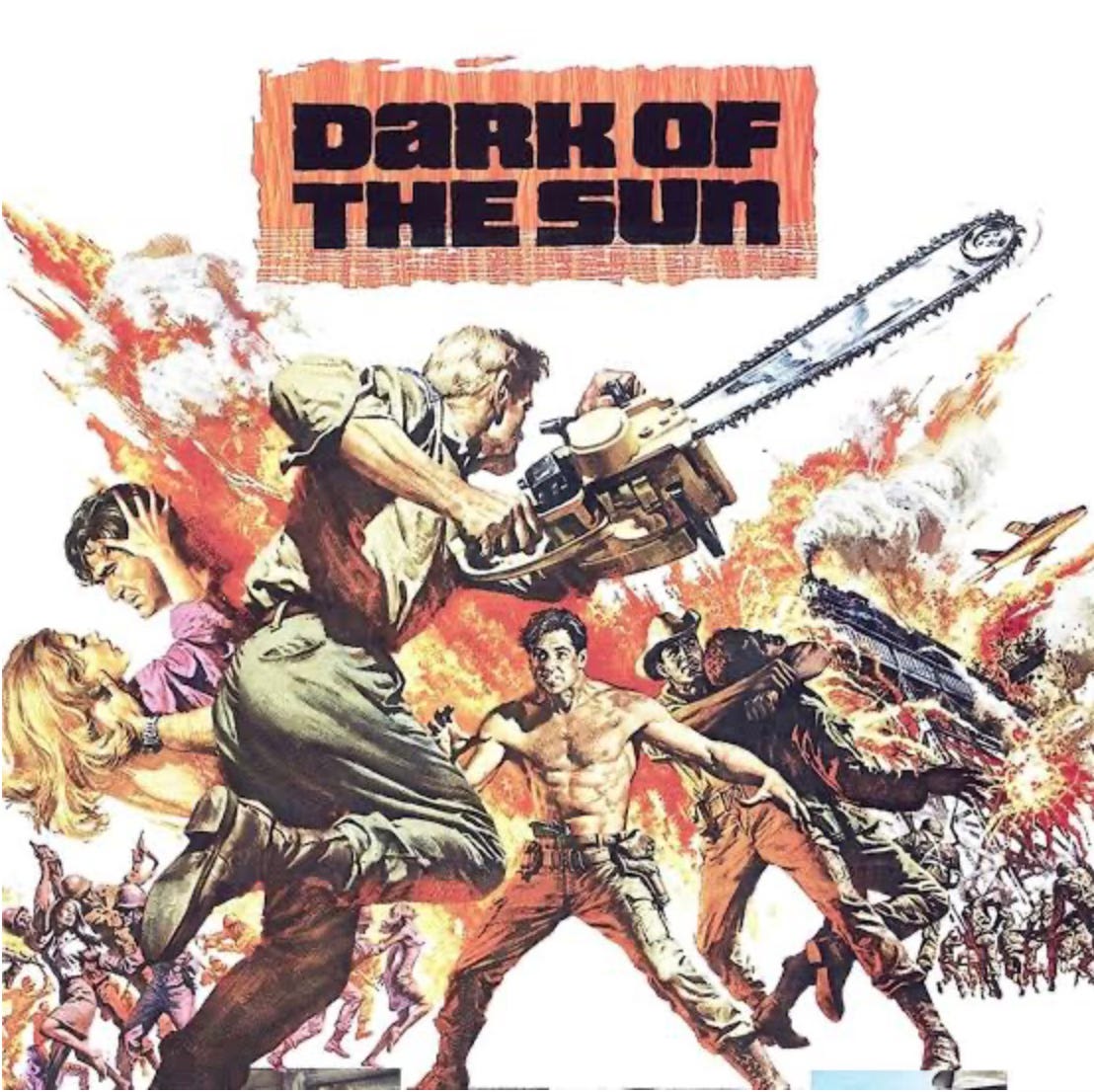
After finishing the book I did go and watch the 1968 adaptation starring Rod Taylor. A little bit of trivia, Quentin Tarantino is apparently a mega fan of the movie and paid homage to it in Inglorious Bastards by using some of the score and using Rod Taylor in a cameo as Winston Churchill.
The movie is very good as a movie, but is anything but a faithful adaptation of the book. Haig’s character is replaces with Dr. Wreid, who is an actual alcoholic and still a doctor and has a much worse character arc in the movie. Curry, Ruffo, and Shermaine make it to the big screen. The romance is kept in but the rape is not. Ruffo gets a much bigger role thematically, as he is Congolese and plays moral counterargument to Curry’s mercenary character. Curry is there for money, while Ruffo is there to try to save his country. There is also some quite good dialogue between the two, the dynamic is perhaps the only thing the movie changed that actually worked, although the book didn’t need it. Perhaps most egregious is the change to Wally Hendry. Hendry’s character is replaces with Heinlein an ex-Nazi who is slightly less pscyho than Hendry and leads the Belgian Legionaries they take along with him. The ex-Nazi backstory is somewhat funny and a cheap shorthand to say he’s the bad guy, keep your eye on him. Unfortunately, his character is a significant downgrade from Hendry. The rape at the end that instigates Curry’s revenge fueled chase through the bush is traded for the murder of Ruffo.
The ending was also supremely gay and subversive in a boomer classic liberalism sort of way. After Curry brutally kills Heinlein for murdering Ruffo and stealing the diamonds, one of the African conscript named Kataki (now taking the place of Ruffo thematically), tells Curry that what he did was wrong (uncivilized is the subtext here) and that he must stand trial. Curry tells him to go pound sand and they start back towards home base. Along the way, Curry replays some of the convos he had with Ruffo and then stops the convoy and turns himself over to Kataki for court martial. Roll credits.
Are you fucking kidding me? Uncivilized? Court martialed by who? The inept Belgian government. It’s actually really funny in a hindsight is 20/20 sort of way to see this very American classic liberal law and order moral orientation (what I have started to call The Rifleman morality) baked into what is otherwise a pretty violent and dope movie about mercs in Africa.
Wilbur Smith, South African based chad that he was, would never, and he didn’t. He wrote a very based, perhaps even Nietzschean pulp thriller that ends with the bad guy getting put into the ground and it being declared good!
Novel is easy five stars. Movie is good, but I’m sour on the changes and the ending.

A most enlightening, edifying, and entertaining read—thank you. Was not familiar with the work (and didn't read the spoiler section); so, will give it a read. (And trust you've read Conrad's "Heart of Darkness", which I recently finished. Continues to haunt.) Continued success in your good work on this platform.
I appreciate the detailed review, and this story has aged well over some sixty years.