

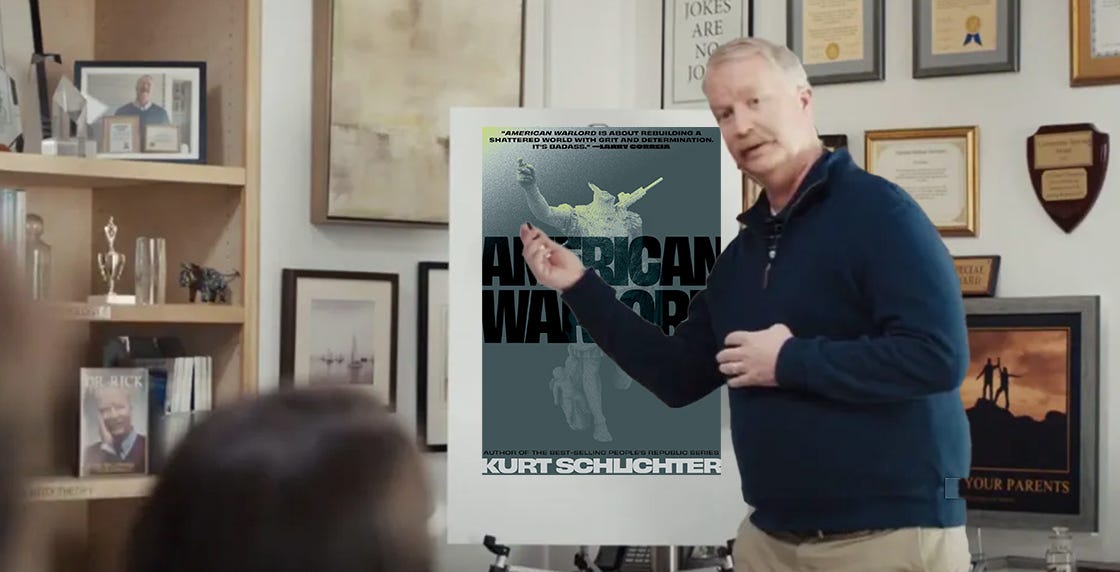
This review, despite the title and the meme above is actually not meant to be mean-spirited. I recently finished Ark Press’ new release American Warlord by Kurt Schlichter, a book I was somewhat excited about based off the banging title, cover, and blurb. Add to that the fact that I love what Ark Press is doing, I was excited to support. They are of course trying to offer a selection of novels and books that are high quality and not drenched in leftist ideology. While everyone else whines about the culture war, they are doing. And I should add, they are doing in a way that is not Daily Wire conservative-slop… for the most part.
This novel unfortunately got perilously close to this at times, but it at least remained generally enjoyable. New books even being bearable is something of a new experience for me. So on that front, they get an A. However, did I particularly enjoy this book? I can’t say I did. It was probably going to be DNF had I not had a long drive in front of me and the promise of a Substack review ahead of me.

The high level synopsis of the book is that our main character Vic Kinkaid, a forty something widower who runs dispatch for a Houston trucking company becomes a warlord in “post apocalyptic” America after the “fall of the Republic.” Vic’s defining feature is that he is something of a history nerd, specifically a Roman history nerd. The premise of the novel is that it is this knowledge of Roman history and military tactics that both clues Vic into the coming disaster and gives him an advantage in rebuilding civilization after the fall.
Pretty interesting premise but the execution left a lot of potential on the table. First, I was surprised towards the end of the book when Vic’s age is revealed to be in his mid-forties, mostly because he legitimately talks and acts like a boomer. This is the apocalypse from the point of view of your cranky uncle that reads Tom Clancy and listens to Dan Carlin’s Hardcore History and has Livy on his shelves but has never actually cracked the books open (that’s what Roman history podcasts are for).
Hence, American Fudd.
“OODA Loop” (observe, orient, decide act) is casually dropped in dialogue in the opening pages of the story. Immediately, I knew I had been teleported into fudd land. For those that don’t know, OODA loop is a four step decision making framework created by United States Air Force Colonel John Boyd in the 1970s. It’s still taught by the military today. And it’s ultimately a fine heuristic for keeping your head in intense situations. It’s designed to drive forward action and avoid analysis paralysis, but I can promise you that only the most autistic among us ever think about the acronym again after learning what it stands for. The magic of the OODA loop is integrating it into training until it becomes second nature. It’s also baby’s first dad acronym.
I guess my point in talking about all of this is that given the premise I would expect a bit more depth to what’s going on and not wikipedia level references. Vic, given that he does actually sit down and read these books in the novel, still came across like he only cruised Roman twitter threads and listened to podcasts. And maybe, this is a spurious and unreasonable critique and my autism is getting in the way. After all, this is genre fiction designed to be legible to the general reading public and on that front, it is. None of this is meant to be hate. It’s just some analysis of my likes, dislikes, and preferences, as well as lessons I’ve pulled out of it as I go forth on my own writerly journey.
I will also say, the “apocalypse” itself was lacking. The thrust is that America breaks down into a civil war while in the middle of a Covid pandemic. Personally, I would have picked literally anything else to name the “bio-weapon” just to keep it from feeling dated. Which it already does due to the reference.
Vic misses the worst of the societal breakdown (the first two weeks) after the Federal Government nukes the money system and triggers kill switches in all the cars and the electric grid goes down because he is locked in his house trying not to die from an especially bad case of Covid. Personally, I thought this was a clever plot mechanic to keep the story moving and not get bogged down in catastrophe role-play.
The world Vic finds waiting for him is one where there has been a total breakdown of civilization. It’s not exactly clear that there is even a civil war going on or if there was even a civil war. It seems like the money sanctions and infrastructure collapse just more or less transported everyone straight into mad max scavenger mode.
Vic slowly collects a band of survivors, mostly families, and helps train them and keep them alive. As they get bigger and more effective they start to look for a place with farms to settle.
Spoilers Ahead
I will stop here to give some props. Vic runs his outfit as a “dictatorship.” That is to say, he is a warlord. When a couple of his guys try to mutiny because they don’t like all his rules or the chain of command, he very promptly puts them down. He even uses guile to do it (removing their firing pins) and then shoots them when they try to kill him.
When Vic and his band find Julian (a small farming community) where they want to settle and get told to pound sand, Vic wastes no time in just taking it over. He offers the residents the chance to join or die, basically.
I have to give props to both of these character moments and set pieces because Kurt didn’t avoid the moral dilemmas of being a warlord. It’s good to push the audience on this front and not just write “liberal” values. Vic is also not an action hero. He doesn’t brawl for top spot. He wins it through guile, discipline, and brutality, and leadership.
I think there was much more to explore there thematically, but this isn’t a long book, and may even be the first in a series. Hopefully, we get more serious ethical dilemmas in future entries.

I will also say, the Vic we meet at the beginning of the book doesn’t necessarily match up real well with Warlord Vic. It’s not clear where he got this ability to be brutal. He ties it back to Roman history throughout, so we are meant to believe that Vic is just leaning on Roman leadership principles to make these necessary calls. That isn’t quite as compelling as if Vic had responded too softly to the mutiny and gotten someone else killed or was left for dead and then learned the lesson of brutality the hard way and came back better for it. That makes for better fiction in my opinion, but alas.
It also all rings a little hollow because from an anthropological point of view and even a historical one, the Romans didn’t just show up as Romans (or previously as Trojans). Principles of violence and dictatorship and patriarchy and rule of law don’t just show up. They are created by roving bands of barbarians and warlords that rape and pillage and fight and then settle and have to create laws and norms to keep order.
The third act of the novel turns into a pretty classic western premise. Vic and “the Republic” must defend Julian from a roving band of horse barbarians that are coming to pillage and rape. That’s fine. I’m here for a good western.
But again, it sells the barbarians short. I’m not convinced you can go from 21st Century fudd to Roman dictator without having a citizenry that came from horse barbarian stock. The barbarian is where the martial values of a civilization really come from. Courage, honor, loyalty, discipline, etc.
A much more interesting story to tell along these lines is one where a group of twenty somethings make a war band and over the course of their lives evolve into a primitive tribal society. Maybe, then they discover some Roman writings and try to emulate something better after being soaked in the chaos of barbarian violence and the realities of pack leadership. I’m doing a poor job of explaining what I’m saying here, and ultimately these are all philosophical quibbles.
All of this aside, I personally think that most apocalypse scenarios are deeply overblown and underestimate the human capacity for cooperation. We are a cooperative and social animal at our base. This is how we were created and evolved to be. Our first impulse is not to loot and run around killing and scavenging. At least not in predominantly white populations. Our first impulse is to band together and start problem solving. This may involve spilling blood, but I think that gets sorted out very quickly. You can’t just put genies back in the bottle, which is what apocalypse books try to do by assuming the amassed moral, social, and technical knowledge of the last 6,000 years just disappears when the lights go out. Also, you are telling me peacekeeping and humanitarian missions from the rest of the world aren’t happening immediately? Like where is the military and martial law in all of this? Overall, there is a lot of handwaving going on.
Overall, do I recommend this book? It’s competently written but not exactly new ground. Apocalypse stories aren’t my bread and butter. I know it’s a large genre and I expect this fits in fine. Personally, it wasn’t to my taste, but it was fun to read from the perspective of watching game tape. It also gets big points for exploring a moral premise, even if again, it could have benefitted from playing out what that premise entails a little bit further.


Good in-depth look at this novel, telling me what works and what didn't, plus why. As for politics in story telling, Louis B Meyer had this advice: "You want to send a message? Use Western Union."
Political porn lit is not my cup of coffee (nothing is my cup of tea because tea is gay unless you’re an Englishman). It commits the same fourth-wall breaking as shitlib DEI fanfic. Despite it doing it for a good cause, it’s lame.