

I read a fair amount of non-fiction along with my steady diet of androgenic 20th century novels. My favorite kind of non-fiction (no not Atomic Habits) are typically memoirs or memoir adjacent. War memoirs are good, but so are ones by cowboys, mountain men, big game hunters, the list goes on. Pretty much anything that drops you into the shoes of someone who went through it in a time period or continent that sounds borderline alien to us here and now is what I like to read.
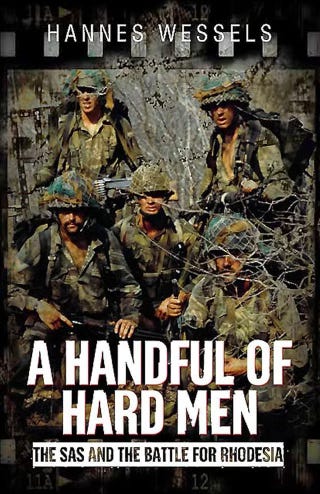
A Handful of Hard Men: The SAS and The Battle for Rhodesia is exactly that. Hannes Wessels focuses primarily on the exploits of elite SAS Captain Darrell Watt in the Rhodesian Bush War (or if you are a communist, The Zimbabwe War of Independence).
This is a fairly quick and riveting read that is not overly dense on the history of Rhodesia or even the conflict at large. However, Hannes pauses throughout the book to expand on the politics and history unfolding around Watt. This gives much needed context, color, and stakes to the operations he is running. Hannes does this masterfully, and so the book reads like the best historical fiction, focusing on the day to day life of Watt and the men he leads, while never leaving you lost as to what is going on in the broader picture. This is really my first journey down the Rhodesian rabbit hole, and as such, I thought it was an excellent starting place.
Hannes also couldn’t have picked a better soldier to tell the story through the eyes of. Watt lived and fought through the entirety of the war against the Zimbabwe People’s Revolutionary Army (ZIPRA), leading men in brutal bush operations up until the very tragic end. Sometimes, these operations even involved cross-border raids into Mozambique. As far as I can tell, he is still alive, and it appears he’s done several recent interviews which you can find on YouTube.
He also only lost one man under his command, which is an absurd achievement for a combat leader, even if it always hung heavy on Watt. It’s also an absurd achievement considering the SAS was almost always outgunned and conducting operations miles behind enemy lines and deep in the African bush. They were often so far out that resupply was impossible, and rescue even more difficult.
One thing noted at the beginning of the book, that I had no idea about, is that the Rhodesian SAS was originally a part of the British SAS. British SAS was filled with Rhodesian fighters before the start of the war since Rhodesia was a British colony. When the conflict started and Ian Smith declared independence, the Rhodesian SAS all headed home. Its also mentioned that the Brits wanted to send in the SAS on the side of ZIPRA at the beginning of the war but there was a near mutiny in the ranks of the British SAS because they roundly refused to go fight their former comrades.
You might be wondering why the Brits refused to help the Rhodesians and would even consider sending the SAS to help communist backed rebels in the middle of the Cold War. And the answer is that at the time, the world was decolonizing. Britain had opted to decolonize Africa and had a policy of no independence prior to majority rule. However, majority rule would prove to be a death sentence for the Rhodesian way of life, a fact proved out by history and the current state of Zimbabwe. And so the liberal idol of democracy trumped all common sense, and even trumped the West’s anti-communist Cold War orientation. In Britains view, it was better that Rhodesia descended into a Marxist state rather than allow its former colonists decide how best to keep it running. There was also a heavy dose of classist politics at play, where the settler Rhodesians were looked down upon as upstarts by the British political establishment. The United States for its part had Jimmy Carter and Kissinger driving the car, so there’s that.

Darrell joined the Rhodesian SAS at the start of the conflict and passed selection at the very top of his class. He was already incredibly fit from spending his teenage years hunting commercially, a job that saw him run/hike like 20 miles every day in the pursuit of game. His experience as a hunter also made him an excellent tracker and marksman. When he got to the SAS, he was what one might call a natural.
From here we follow Darrell through combat operations that take place over the war. This being a recounting of true events means that we have something less than a plot and closer to a consecutive series of vignettes, most all following hair raising encounters with “ters”—Rhodesian short hand for terrorists. Sometimes, Hannes pulls in accounts from other SAS members to help fully flesh out the full picture of a battle or operation which gives the tale a Bernard Cornwell-esque flair.
Also highlighted is the hard partying and messing around that the units got up to back at base camp, or sometimes on mission. Including getting the unit’s resident baboon its jump wings. Speaking of baboons, its mentioned that the ters often chained them up around their camps to act as “gaurd dogs,” which is insane.
A high point in the book is the description of Operation Dingo, an operation largely pulled off due to the superior operational planning and logistical capability of the Rhodesian military.
And then more sadly, the downing of Air Rhodesia Flight 825 and its gory aftermath. ZIPRA executed the survivors to include men, women, and children. These events are recounted by the SAS men on the ground who were the first to respond.
The book ends quite tragically, with Darrell and the rest of the SAS units on the verge of winning the Bush War. Many of the ZIPRA rebels by this point in the conflict were already sick of Marxism and the corrupt leadership in charge of them. Whole ZIPRA armies were surrendering or outright joining with the hardy Rhodesians. Many of them could see the writing on the wall and were beginning to realize that life with the White Rhodesians running things wasn’t so bad, and that majority rule under their new marxist overlords would be three steps backwards.
Unfortunately, the political situation would not allow that to occur. General Peter Walls, Head of the Armed Forces of Rhodesia, and in charge of negotiating a ceasefire between ZIPRA and the Rhodesians was finally successful. On the verge of winning the war, Darrell and his boys were recalled in order to uphold the ceasefire. Walls was of course getting played like a fiddle by the British political apparatus, to include Margaret Thatcher. An election would be held in Rhodesia to determine its political destiny. At the time, Britain was giving Walls assurances that Mugabe (the leader of ZIPRA) would under no circumstances be allowed to take power. Unfortunately, Britain had absolutely no intention of keeping that promise. Elections rife with ZIPRA interference were finally held and Mugabe became president of the newly formed Independent Zimbabwe. While there were several assassination attempts on Mugabe, they all failed. Thatcher declined to answer Wall’s calls. While Darrell and his boys had won every single battle they’d ever fought, an embattled Rhodesia was to lose the war.
The tragedy of this outcome was magnified by having followed the Rhodesian SAS and Darrell through twelve years of hair raising conflict. While the end was a downer, it was ultimately a great read.
Rating: 5/5 dead ZIPRA officers

I'd recommend the memoirs of A.J. Balaam (Selous Scouts), Chris Cocks - Fireforce (Rhodesian Light Infantry), John Cronin - The Bleed (US Marine, Vietnam vet, went to Rhodesia).
The Rhodesian Bush Wars are terribly interesting. I have not read nearly enough on the episode, but found “A Handful of Hard Men” and “We Dared To Win” (a recount of many missions involving Andre Scheepers) to be fascinating. In the end the West deserves credit for the millions of needless deaths after Mugabe came to power. There is a YouTube interview with Watt that is worth a watch.